
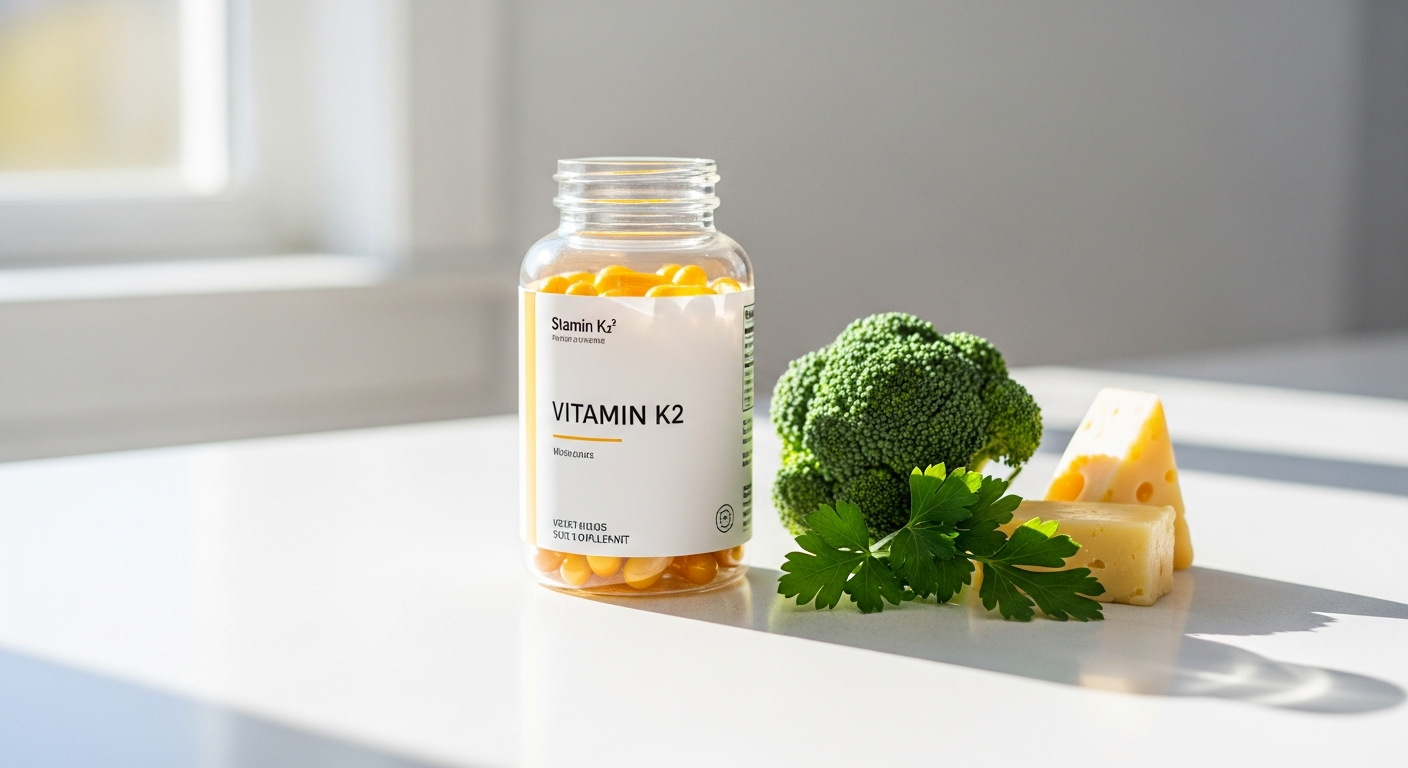
Vitamin K2 is one of the most underappreciated nutrients in human health, yet it plays a crucial role in maintaining strong bones, cardiovascular health, and proper calcium metabolism. While most people are familiar with Vitamin K1 found in leafy greens, Vitamin K2 represents a distinct family of compounds with unique biological functions that extend far beyond blood clotting.
Unlike its well-known cousin Vitamin K1, Vitamin K2 acts as a biological “traffic director” for calcium in your body, ensuring this essential mineral ends up in your bones and teeth rather than accumulating in soft tissues like arteries and organs. This comprehensive guide will explore everything you need to know about Vitamin K2, from its various forms to its health benefits and optimal supplementation strategies.
Contents
Understanding the Vitamin K Family
The vitamin K family consists of two main groups: phylloquinone (K1) and menaquinones (K2). While both are essential for proper blood clotting through their role in activating clotting proteins, they differ significantly in their sources, metabolism, and additional biological functions.
Vitamin K1 is primarily found in green leafy vegetables and is rapidly metabolized by the liver for blood clotting purposes. In contrast, Vitamin K2 comes from fermented foods and animal products, has a longer half-life in the body, and demonstrates superior bioavailability for extrahepatic tissues – organs outside the liver.
The Different Forms of Vitamin K2
Vitamin K2 exists in several subtypes, designated as MK-4 through MK-13, based on the length of their side chains. The two most important and well-studied forms are:
MK-4 (Menaquinone-4): This form has a relatively short half-life of about one hour and is found primarily in animal products like grass-fed butter, egg yolks, and organ meats. MK-4 can also be synthesized in small amounts by gut bacteria from K1.
MK-7 (Menaquinone-7): With a much longer half-life of approximately 72 hours, MK-7 remains active in the bloodstream longer and shows better accumulation in tissues. It’s primarily found in fermented foods, with natto (fermented soybeans) being the richest natural source.
How Vitamin K2 Works in Your Body
The primary mechanism of Vitamin K2 involves the activation of vitamin K-dependent proteins through a process called gamma-carboxylation. This biochemical process enables these proteins to bind calcium and direct it to appropriate locations in the body.
Key Vitamin K2-Dependent Proteins
Osteocalcin: Often called the “calcium-binding protein,” osteocalcin is produced by osteoblasts (bone-building cells) and requires K2 activation to effectively incorporate calcium into bone matrix. Without adequate K2, osteocalcin remains undercarboxylated and cannot perform its bone-building function optimally.
Matrix Gla Protein (MGP): This protein acts as a powerful inhibitor of soft tissue calcification. When activated by K2, MGP prevents calcium from depositing in arteries, cartilage, and other soft tissues where it doesn’t belong.
Research demonstrates that vitamin K2 supplementation significantly improves the carboxylation status of both osteocalcin and MGP, leading to improved bone and cardiovascular health outcomes, 2009.
Health Benefits of Vitamin K2
Bone Health and Osteoporosis Prevention
Vitamin K2’s role in bone health extends beyond simply directing calcium to bones. It works synergistically with vitamins D3 and A, along with minerals like magnesium, to optimize bone mineralization and maintain bone density throughout life.
Studies consistently show that populations with higher K2 intake have lower rates of hip fractures and better bone mineral density. The vitamin appears particularly important for maintaining trabecular bone – the spongy inner bone tissue that’s most susceptible to age-related loss.
Cardiovascular Health
Perhaps one of the most exciting areas of K2 research involves cardiovascular health. By activating MGP, K2 helps prevent arterial calcification – a key factor in atherosclerosis and cardiovascular disease.
The Rotterdam Study, a large-scale population study, found that individuals with the highest dietary K2 intake had a 57% lower risk of dying from heart disease compared to those with the lowest intake. This protective effect was not observed with K1 intake, highlighting K2’s unique cardiovascular benefits.
Dental Health
K2 plays a crucial role in dental health by activating osteocalcin in tooth dentin and supporting the remineralization process. Traditional cultures with high K2 intake consistently showed excellent dental health with minimal tooth decay, as documented by researcher Weston A. Price in the early 20th century.
Hormonal Balance and Metabolic Health
Emerging research suggests K2 may influence insulin sensitivity and glucose metabolism. Osteocalcin, when properly activated by K2, appears to act as a hormone that stimulates insulin production and improves insulin sensitivity in peripheral tissues.
Natural Food Sources of Vitamin K2
Fermented Foods
Fermented foods represent the richest dietary sources of K2, particularly the long-acting MK-7 form. Natto leads the list with approximately 1000 mcg of K2 per 100-gram serving. Other fermented foods like sauerkraut, kefir, and certain aged cheeses also contain meaningful amounts of K2.
Animal Products
Animal products, particularly from grass-fed or pasture-raised sources, contain significant amounts of MK-4. Grass-fed butter, egg yolks from pastured chickens, organ meats, and full-fat dairy products are excellent sources. The K2 content in animal products directly correlates with the animal’s K1 intake from fresh grass.
Modern Diet Limitations
Unfortunately, modern Western diets often provide insufficient K2. The decline of fermented foods in the typical diet, combined with the predominance of grain-fed rather than grass-fed animal products, has significantly reduced K2 intake compared to traditional diets.
Vitamin K2 Supplementation
Choosing the Right Form
When selecting a K2 supplement, the choice between MK-4 and MK-7 depends on your specific health goals and preferences. MK-7 supplements offer the advantage of once-daily dosing due to their longer half-life, while MK-4 may require multiple daily doses for optimal effect.
Recent research indicates that MK-7 supplementation provides more stable serum levels and better accumulation in extrahepatic tissues compared to MK-4, 2012.
Optimal Dosing
Effective K2 supplementation dosages vary depending on the form used. For MK-7, research supports doses ranging from 45-180 mcg daily for general health maintenance, while therapeutic applications may require higher doses. MK-4 supplementation typically requires higher doses, often in the range of 15-45 mg daily, due to its shorter half-life.
Synergistic Nutrients
K2 works optimally when combined with other fat-soluble vitamins, particularly vitamin D3. These nutrients have complementary functions in calcium metabolism – D3 increases calcium absorption while K2 directs it to appropriate tissues. Vitamin A also plays a supportive role in this process.
Safety Considerations and Interactions
Vitamin K2 is generally well-tolerated with no established upper intake limit for healthy individuals. However, people taking anticoagulant medications like warfarin should consult healthcare providers before supplementing, as vitamin K can affect blood clotting mechanisms.
Unlike synthetic vitamin K3, natural forms K1 and K2 do not appear to cause toxicity even at high doses. Studies using therapeutic doses of K2 have not reported significant adverse effects, making it a relatively safe nutrient for most people.
The Future of Vitamin K2 Research
Current research continues to uncover new roles for vitamin K2 in human health. Scientists are investigating its potential effects on cancer prevention, brain health, exercise performance, and longevity. Preliminary studies suggest K2 may have neuroprotective properties and could play a role in maintaining cognitive function with aging, 2014.
Frequently Asked Questions
Can I get enough Vitamin K2 from food alone?
While it’s possible to obtain K2 from foods, it requires consistent consumption of fermented foods like natto or high-quality animal products from grass-fed sources. Most people following a typical Western diet would benefit from supplementation to achieve optimal K2 levels.
How long does it take to see benefits from K2 supplementation?
Some biomarkers of K2 status can improve within days to weeks of supplementation, but clinically meaningful changes in bone density or cardiovascular health typically require several months to years of consistent supplementation.
Should I take K2 with food?
Yes, as a fat-soluble vitamin, K2 is best absorbed when taken with dietary fat. Taking your K2 supplement with a meal containing healthy fats will optimize absorption and bioavailability.
Is MK-4 or MK-7 better?
Both forms have unique advantages. MK-7 offers convenience with once-daily dosing and longer tissue residence time, while MK-4 may be more effective for certain applications and is the form most commonly found in human tissues. Some experts recommend combination supplements containing both forms.
Can children take Vitamin K2 supplements?
Vitamin K2 is important for growing children, particularly for proper bone and dental development. However, dosing for children should be adjusted based on body weight and determined in consultation with a pediatric healthcare provider.
Medical Disclaimer
This information is for educational purposes only and is not intended to replace professional medical advice, diagnosis, or treatment. Always consult with qualified healthcare providers before starting any supplementation regimen, especially if you have existing health conditions or take medications. Individual responses to supplements may vary, and what works for one person may not be appropriate for another.